The Rise of AI-Native Professionals in 2026

For most of the last two decades, knowledge work has been defined by tools people operate. You open software. You search for information. You write documents. You manually move work forward.
Even when tools improved, the underlying model stayed the same. Humans operated tools. That model is starting to break.
A different kind of professional is emerging. One who doesn't just use software. One who works alongside AI systems that actively help them think, prepare, and execute.
But most teams haven't felt this shift yet because the tools they use still treat every meeting, every conversation, and every decision as a one-time event. Context gets lost. Follow-ups fall through. Institutional knowledge lives in people's heads, not in systems that can use it. The gap between how work could flow and how it actually flows keeps growing.
This shift isn't just about productivity. It's about a new operating model for knowledge work entirely.
In this piece, we'll show you what that model looks like, who is already building workflows around it, and why the gap between those who do and those who don't will only widen from here.
What Is an AI-Native Professional?
These are people who do not treat AI as a chatbot they occasionally prompt. Instead, they design workflows where AI systems are continuously involved in their work. Their tools don't sit idle waiting for instructions. They anticipate. They surface knowledge. They generate insights. They help move work forward.
In many ways, the AI-native professional works less like an individual contributor and more like the orchestrator of intelligent systems. They are not doing every step themselves. They are directing a network of tools and agents that amplify their thinking and execution.
"The question is no longer whether AI will change knowledge work. It's whether your team will be on the side that designed for that change - or the side still catching up to it."
Why This Shift Is Happening Now
Three structural forces are converging to make AI-native work not just possible, but necessary for modern teams.
The volume of context has outpaced human capacity
Sales teams are running more calls. GTM leaders are managing more stakeholders. Decisions are moving faster. The amount of context a professional needs to hold and act on has grown dramatically - while the hours in a working day have not. Something has to give. Either context gets dropped, or something else carries it.
AI has crossed the usability threshold
A few years ago, AI tools required significant setup and tolerance for inconsistent output. That era is ending. Tools like Simplora now connect directly to the systems your team already uses - Slack, Notion, Gmail, your CRM, Zoom, Google Meet, Microsoft Teams - and operate as an intelligent layer across the full meeting lifecycle with no workflow disruption required. The barrier to entry has disappeared.
The cost of manual knowledge work is finally visible
When every post-call summary and every follow-up email used to take time, that cost was invisible - just part of the job. Now, as agentic systems handle those tasks automatically, the manual approach starts looking like an active choice to operate slower than you need to.
The Shift From Tools to Agents
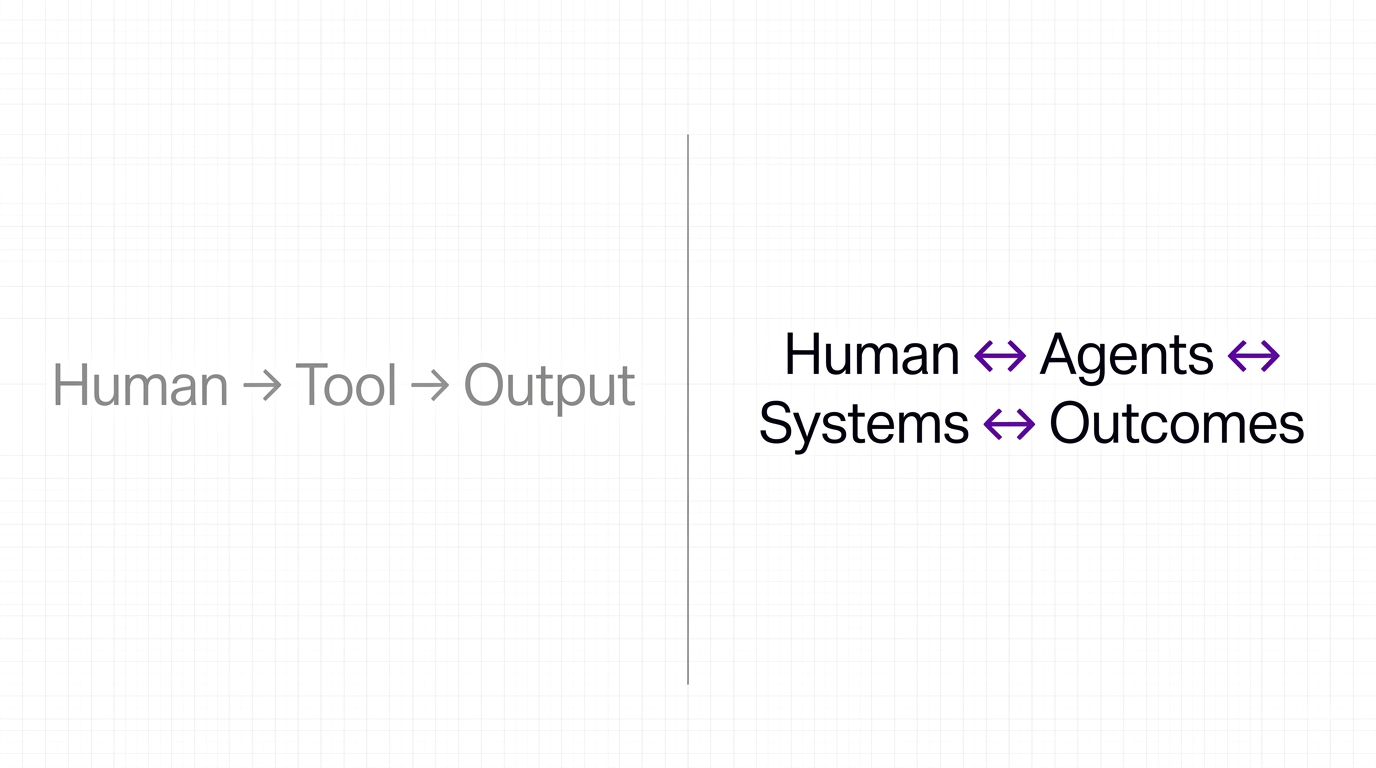
Traditional software follows a simple structure:
Human → Tool → Output
You open the tool. You input instructions. The tool produces something.
AI-native work looks different:
Human ↔ Agents ↔ Systems ↔ Outcomes
Instead of tools that wait to be used, we now have systems that can:
- Research information and build context automatically
- Generate insights and surface relevant knowledge
- Maintain memory and continuity across work
- Execute tasks and trigger workflows without being asked
This is the beginning of agentic work. Not just automation. Not just copilots. But systems that actively participate in how work gets done.
Meetings are where this shift is most visible - and most consequential. Every conversation a professional has carries context, commitments, and decisions that need to go somewhere. For most teams, they don't. They disappear into inboxes and memories. Agentic systems change that by making every conversation a structured, searchable, actionable asset - automatically.
Humans and Agents Working Together
The most important shift isn't that AI replaces humans. It's that humans begin working alongside intelligent systems that absorb the cognitive overhead surrounding their actual work.
Before a meeting starts, an agent can gather relevant context - participant backgrounds, past conversations, key topics likely to surface - so the professional arrives fully briefed rather than scrambling.
While the conversation is happening, another system can surface relevant documents, retrieve answers from the organization's knowledge base, and maintain continuity with previous interactions involving the same account or project. The professional stays present. The intelligence runs in the background.
After the meeting ends, agents capture outcomes, organize knowledge into structured outputs, and trigger the next steps automatically. The post-meeting burden - the write-ups, the follow-ups, the CRM updates - disappears.
Instead of individuals carrying the full cognitive load of knowledge work, professionals begin operating with a layer of intelligent support around them. Thinking becomes augmented. Context becomes accessible. Execution becomes faster.
The professional is no longer working alone. They are working with systems that continuously help them move forward.

What AI-Native Work Looks Like for Real Teams
Sales and GTM teams
The old version of a sales rep's day looked like this: 30 minutes of manual research before the call, split attention between listening and writing notes during it, and another 20 minutes of documentation after. All three done partially, none done well.
The AI-native version looks different. The brief arrives before the call without anyone asking for it. During the conversation, when an objection surfaces or a prospect asks a question that needs a specific answer, the context is already there. And the moment the call ends, the recap - summary, action items, next steps - is already written.
For teams running longer sales cycles, the continuity across calls is the part that changes everything. Every new conversation with an account picks up exactly where the last one left off. No one has to remember. No context falls through the cracks between calls three weeks apart. The rep's job becomes purely the relationship - the highest-value part of selling.
Customer success and account management
Account managers operate on trust - and trust depends on remembering. The promise made on a call six weeks ago. The concern raised in passing last month. The goal the customer mentioned once and never brought up again.
Right now, that memory lives in people's heads. When someone leaves, or simply forgets, that context is gone. When a customer feels like they have to repeat themselves, the relationship takes a quiet hit.
When every customer conversation is captured and connected to a searchable knowledge system, that institutional memory stops being personal and starts being organizational. The full history of every touchpoint is immediately accessible to the whole team - not just the one person who was on the call.
Leadership and cross-functional teams
Leaders rarely lack information. They lack the ability to see across it. Which topics keep surfacing across different team meetings? Where are decisions getting stuck and why? What's the cross-team context on a deal that's stalling?
These questions used to require someone to manually pull together notes from half a dozen conversations and synthesize them. Most of the time, nobody did - and leaders operated on instinct where they could have operated on evidence. When meetings become a searchable knowledge base, patterns that were previously invisible become something you can actually see, track, and act on.
Simplora: The Agentic Meeting Stack
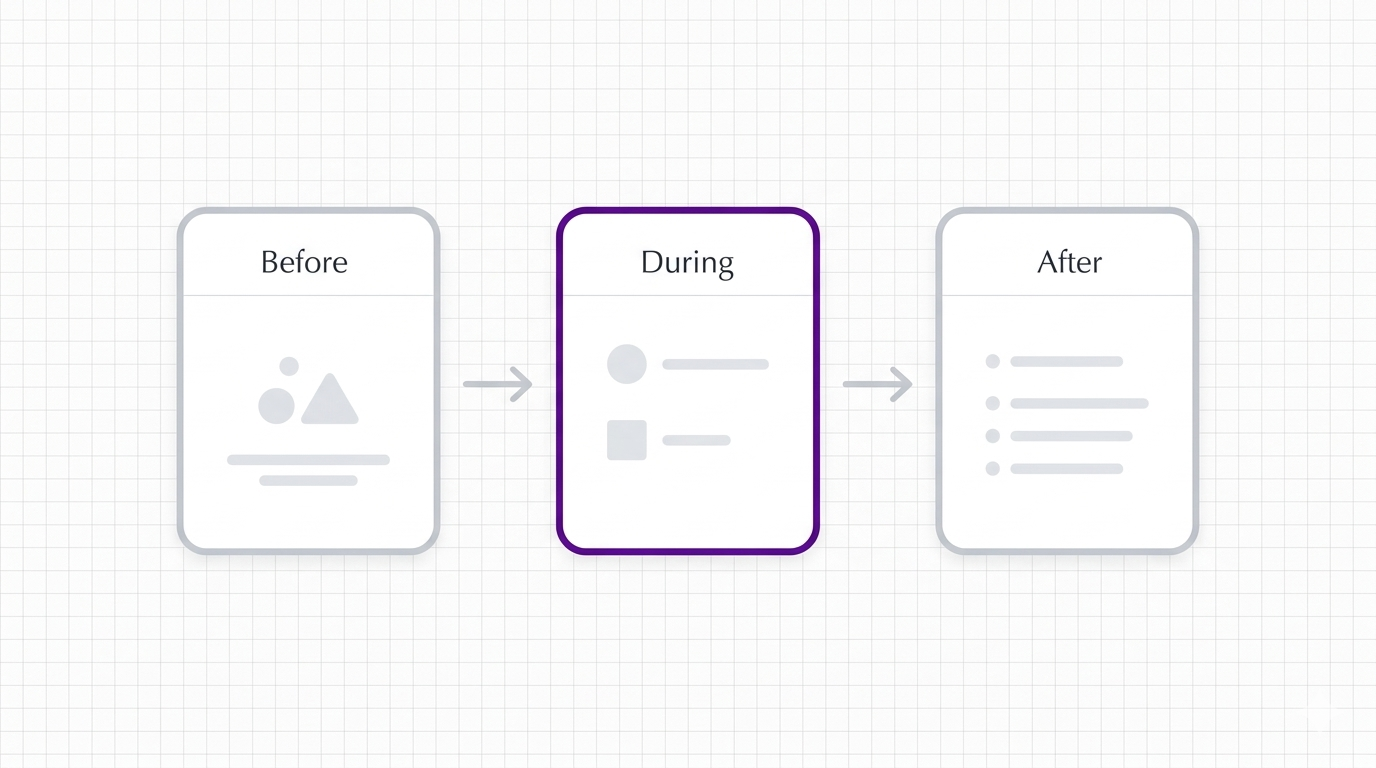
Simplora unifies meeting preparation, conversation intelligence, execution, and analysis for modern teams - approaching every meeting as part of a continuous conversation lifecycle, not an isolated event. Here's exactly how each phase works.
Pre-meeting - AI meeting briefs
Walking into a meeting without context isn't a preparation problem - it's a systems problem. Simplora solves it by generating a contextual brief before every call, built from your real organizational data rather than a generic template.
- Participant details and background
- Insights from previous meetings with the same account
- Relevant discussion topics likely to come up
- Context pulled automatically from Slack, Notion, Gmail, and your CRM
During - Real-time contextual intelligence
The best conversations happen when your full attention is on the person across from you - not on searching for an answer mid-call. Simplora stays active in the background, surfacing what's relevant the moment it becomes relevant.
- Surfaces related documents and internal resources automatically as topics arise
- Retrieves verified answers from your org knowledge base for live prospect questions
- Helps sales reps respond to objections confidently without breaking the conversation to search elsewhere
Across meetings - Memory of questions & resources
Most tools treat every meeting as a clean slate. Simplora treats them as chapters in the same ongoing conversation. By connecting insights across past interactions with the same account, it gives your team the kind of continuity that used to depend entirely on individual memory.
- Links insights from past conversations with the same account automatically
- Maintains context continuity throughout longer sales cycles
- Ensures every new conversation picks up exactly where the last one left off - regardless of who was on the previous call
Post-meeting - Structured recaps, not just transcripts
A raw transcript is data. A structured recap is knowledge. Simplora converts every conversation into an organized asset your team can act on immediately - no cleanup, no manual write-up required
- Generates a clear meeting summary outlining what was discussed and decided
- Highlights key takeaways so important signals aren't lost in the transcript
- Extracts action items automatically with clear owners and next steps
- Organizes concepts discussed for easier reference across meetings
- Links resources mentioned during the conversation automatically
- Stores a searchable transcript and recording, findable by keyword, speaker, or topic
Analysis - Ever-evolving knowledge base
Individual recaps are useful. A connected system of recaps is transformative. Over time, Simplora builds an organizational knowledge base from every conversation your team has - making the collective intelligence of your meetings searchable, analyzable, and compounding.
- Recaps organized across folders, projects, and teams
- Cross-meeting pattern and performance analysis
- Every conversation becomes searchable organizational intelligence
Works with: Zoom · Google Meet · Microsoft Teams · Slack · Notion · Gmail · CRM systems
Free plan includes unlimited AI meeting prep, notes, and chat. No credit card required. Switching from another tool? We migrate your existing transcripts so you lose zero context.

The Professionals Who Thrive Next
The next generation of top performers will not simply be the most skilled individuals. They will be the ones who learn how to operate in partnership with intelligent systems. They will orchestrate tools, agents, and knowledge. They will build workflows where thinking, research, and execution are continuously supported.
They will move faster not because they rush, but because the friction between questions and answers disappears.
Over time, this will create a visible divide. Professionals who still operate manually. And professionals who operate AI-natively. The gap between them will grow quickly - because once someone learns how to work with intelligent systems, it becomes very difficult to go back.
At Simplora, this is the shift we're building for. Not better note-taking. Not prettier transcripts. A fundamentally different relationship between professionals and the meetings that drive their work - where every conversation leaves behind structured intelligence that compounds in value over time.
A new kind of professional is emerging. And we are only at the beginning.
Meetings Don't Have to Create More Work
Simplora is the agentic meeting stack that handles preparation, real-time intelligence, structured recaps, and organizational knowledge - so your team can focus on the conversations that matter, not the overhead around them.
Ready to experience intelligent meeting platform?
Get unlimited AI meeting notes free forever. Try our Pro plan free for 14 days to experience live meeting intelligence.
No credit card required • 14-day Pro trial • Unlimited free AI notes forever
Frequently Asked Questions
What is an AI-native professional?
An AI-native professional integrates AI systems directly into daily workflows. Instead of using AI occasionally, they work alongside intelligent tools that support research, preparation, and execution.
What is an agentic meeting stack?
An agentic meeting stack is an AI system that supports the full meeting lifecycle - preparation, real-time insights, and post-meeting execution, turning conversations into structured knowledge.
Is AI replacing knowledge workers?
No. AI mainly reduces operational tasks like research and note-taking. Professionals who adopt AI systems can focus more on strategy and decision-making.
What does Simplora do before a meeting?
Before meetings, Simplora generates an AI meeting brief with participant details, previous conversation insights, and relevant context from tools like Slack, Notion, Gmail, and CRM systems.
How does Simplora help during meetings?
During meetings, Simplora provides real-time meeting intelligence, surfacing documents, internal knowledge, and verified answers from connected systems.
How is Simplora different from other AI note taking apps?
Most AI note taking apps focus only on transcripts and summaries. Simplora supports the entire meeting lifecycle with AI briefs, real-time insights, and structured recaps.